Table Of Content

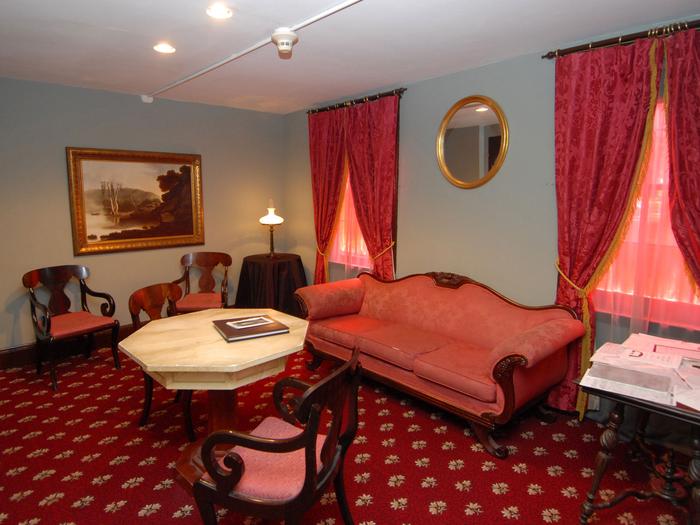
Around the time he lived here, his failed literary endeavors and his ailing wife’s costly medical care finally forced him to file for bankruptcy. His bankruptcy petition lists hardly any furniture or valuable material possessions.Poe had elite tastes in furniture and décor that were beyond what he could afford, but one aspect of the parlor might have attracted his sensibilities. The mantle above the fireplace is made of marble, one of the most elegant aspects of the house.
Culture Trip Spring Sale
Come to Baltimore during the first weekend in October to attend the International Edgar Allan Poe Festival & Awards. Enjoy a bevy of Poe-themed events, including performances, tours and family-friendly activities. You can also visit Poe’s final resting place just a few blocks away at the Westminster Hall & Burying Ground. Poe’s death is shrouded in mystery—he was found in a gutter in Fell’s Point and suffered from delirium for days before passing—but it’s widely believed that the city’s oldest bar was one of his last stops before his death. The Horse You Came In On Saloon opened in 1775 and today is known for its dive bar vibe and live music, but also enjoys the occasional ghost sighting.
Edgar Allan Poe Cottage
The house was saved by the efforts of the Edgar Allan Poe Society of Baltimore, which made arrangements with the city of Baltimore and opened the home as The Baltimore Poe House in 1949. Poe was born in Boston, the second child of actors David and Elizabeth "Eliza" Poe.[4] His father abandoned the family in 1810, and when his mother died the following year, Poe was taken in by John and Frances Allan of Richmond, Virginia. They never formally adopted him, but he was with them well into young adulthood. He attended the University of Virginia but left after a year due to lack of money.
The Poe Museum

The Poe Memorial Association eventually reorganized as the Poe Foundation, which was tasked with operating the Poe Shrine. Among the Poe Foundation’s notable presidents was two-time Pulitzer Prize-winning historian Douglas Southall Freeman, who guided the institution through the lean years of the Great Depression and was responsible for changing the name of the Poe Shrine to the Poe Museum. The Poe Museum’s collection is the most comprehensive in the world and its influence reaches millions of scholars, students, teachers, and literary enthusiasts every year.
CT theatre to become the Edgar Allen Poe Speakeasy next month - CTPost
CT theatre to become the Edgar Allen Poe Speakeasy next month.
Posted: Tue, 31 Oct 2023 07:00:00 GMT [source]
Poe may have seen the beautiful mantle as a consolation prize for renting an otherwise plain house.One of the most notable details in the room is the word “death” carved into the plaster near the doorway to the kitchen. It is unknown whether Poe made this carving, but he did have a habit of writing and drawing on the walls of his dorm room at the University of Virginia. His beloved wife was fatally ill while he lived here, so thoughts of death were certainly on his mind. In disrepair by the 1890s, the Fordham cottage was saved by the New York Shakespeare Society, which lobbied the New York City Legislature to have it moved about 450 feet north of its original location on the east side of Kingsbridge Road near 192nd Street.
The Enchanted Garden
Which Edgar Allan Poe Stories Are in 'The Fall of the House of Usher'? - Collider
Which Edgar Allan Poe Stories Are in 'The Fall of the House of Usher'?.
Posted: Tue, 10 Oct 2023 07:00:00 GMT [source]
Fearing that her body will be exhumed for medical study, Roderick insists that she be entombed for two weeks in the family tomb located in the house before being permanently buried. The narrator helps Roderick put Madeline's body in the tomb, whereupon the narrator realizes that Madeline and Roderick are twins. The narrator also notes that Madeline's body has rosy cheeks, which sometimes happens after death.
Preserved homes, landmarks, and museums
Over the next week, both Roderick and the narrator find themselves increasingly agitated. Edgar Allan Poe moves into the three-story brick property of No. 530 with his family at some point during this time period. At that time, the house was connected to the rear of No. 532 which was much larger than No. 530. No. 530 was described at the time as looking like “only part of a house.” No. 530 would later become a backbuilding to No. 532. Caspar and Abraham Sharpless sell No. 530 and No. 532 to William Alburger for $1. Alburger pays a yearly rent to the Sharplesses of $102 for No. 530 and a yearly rent of $114 for No. 532.
Further, Roderick believes that his fate is connected to the family mansion. For Edgar Allan Poe’s bicentennial, the site opens with extensive new exhibits on the author’s life and legacy. As an alternative to restoration, pictures on large canvases that give a generalized idea of how the rooms may have appeared are placed throughout the historic structure.
October 4, 1841
Established in 1906 as the Poe Memorial Association, this organization failed to generate enough public support for the monument. Ten years later the members regrouped to save the Southern Literary Messenger building and create the National Poe Museum inside. The city’s building inspector decided to have the building demolished as part of a plan to widen Fifteenth Street (the city eventually widened Fourteenth Street instead.) Undeterred, Whitty salvaged the building materials to use elsewhere. He met historic preservationists Archer and Annie Jones who were renting Richmond’s famous Old Stone House. Mrs. Jones decided the empty lot behind the house would be a fitting location for a Poe memorial garden, and Whitty allowed her to use the bricks and granite from the Southern Literary Messenger building to pave the garden paths and to build a shrine to Poe. Poe Baltimore is committed to enriching the experience of visitors to Baltimore, who come to witness the city that inspired Edgar Allan Poe and his intellectual and literary heirs.
We are committed to protecting, preserving and celebrating the rich history of the city, the house, and the legacy of one of our most beloved denizens. While touring the house, visitors interact with exhibits that help bring Poe and his writing to life, including acting like one of his storied detectives to decipher a code and listening to audio recordings of famous voices reading his work. Although best known for his Gothic horror tales like “The Raven” and “The Tell-Tale Heart”, Poe also created beautiful poetry, was a pioneering science fiction writer and is credited with inventing the modern detective story with Murders in the Rue Morgue.
Edgar Allan Poe’s great-grandfather established the family in Baltimore in 1755. Poe lived with his aunt in a small duplex on North Amity Street in Baltimore from about 1832 until the fall of 1835. During this period, he composed poetry, wrote literary criticism and penned some of his earliest short stories like “MS. Found in a Bottle” and “Berenice.” Visit the Poe House and Museum to see the writing desk and chair where he created some of his famous work. In the 1930s, homes in the area, including Poe's, were set for demolition to make room for the "Poe Homes" public housing project.
There was a spacious lawn facing Seventh Street, where Muddy could frequently be seen. Clemm was always busy… clearing the front yard, washing the windows and the stoop, and even white-washing the palings [a fence made from pointed wooden stakes]. You would notice how clean and orderly everything looked.” The Poes were respected, though neighbors sometimes speculated about the strange and insular family. One neighbor claimed to have only seen Poe leave the house a dozen times, yet another remembers him frequently laughing outdoors with his wife and mother-in-law.
In the attic, there is a small room that was Poe’s study and a larger room that was his and Virginia’s bedroom. It now contains a TV that shows a 20-minute documentary, featuring an actor playing Poe, about the writer’s Fordham experiences, including his frequent nocturnal wanderings. Surrounded by somber apartment buildings, the white wooden cottage with black shutters sits at the northern end of a narrow park just east of the Grand Concourse at East Kingsbridge Road.
Alburger sells No. 532 to John Evans Jr. on the same day for the same amount. Alburger constructs a “three-story brick [house with adjacent land]” on the property of No. 530 sometime between September 1840 and October 1841. The vertical picture window in the northern end of the visitor center looks out on Poe’s humble cottage, which is open to the public. The cherry and lilac trees that Poe once looked out on from the veranda are long gone. The ground floor consists of a kitchen, a parlor and a tiny bedroom that was probably Maria’s until Virginia was no longer strong enough to mount the stairs.


No comments:
Post a Comment